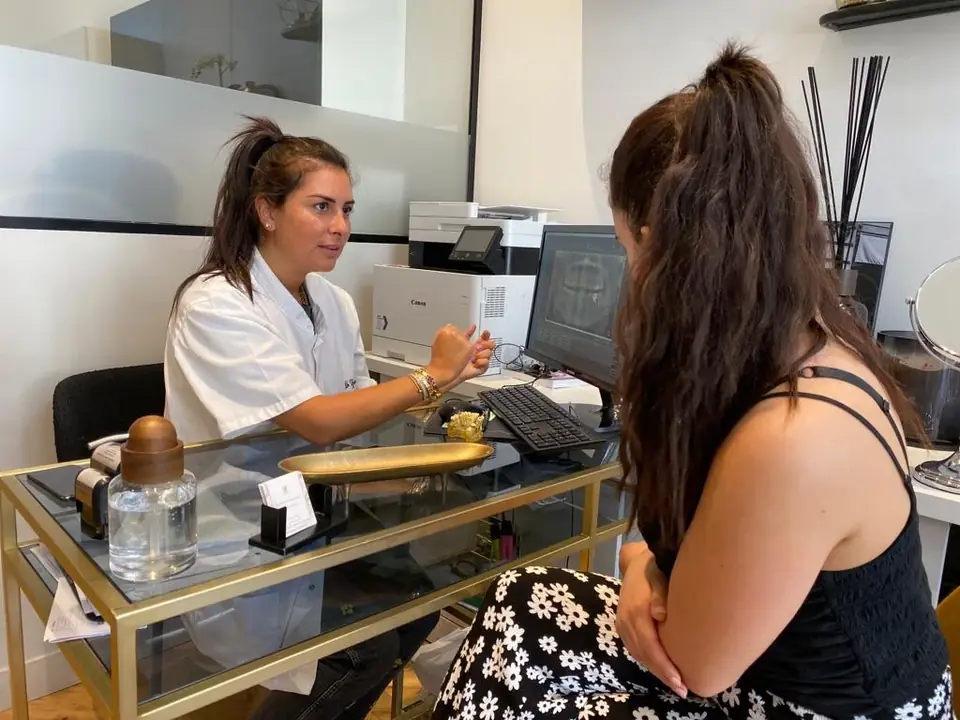
What are white spots?
White spots are areas of the enamel that are more opaque and lighter than the rest of the tooth, caused by a difference in mineralisation — not by surface staining.
Unlike a coffee or tobacco stain that settles on the tooth, a white spot comes from within the enamel: a more porous area scatters the light differently and appears white and chalky. It is most often a cosmetic concern, but one that can be bothersome day to day, especially on the teeth of the smile.
Where do white spots come from?
Several origins are possible; identifying them determines the treatment.
- Hypomineralisation (MIH) — a defect in the formation of the enamel during childhood.
- Fluorosis — an excess of fluoride during the formation of the teeth.
- Post-orthodontic demineralisation — spots that appear around the brackets after treatment.
- Early carious lesion — the very beginning of demineralisation, to be monitored.
The diagnosis of the origin and depth of the spot is made at the first appointment in Paris 8: it determines whether resin infiltration is indicated, or whether another approach is needed.
Resin infiltration (micro-invasive technique)
Infiltration draws a fluid resin into the porous enamel to mask the spot, without trimming the tooth and, most often, without anaesthesia.
The principle: the resin fills the micro-porosities of the white area and takes on a refractive index close to that of healthy enamel. The light then passes through the spot in the same way as the rest of the tooth, and the white area fades. The treatment is conservative: no drill, no loss of tooth structure, and it is generally carried out in a single session.
Indications & limits
Infiltration gives its best results on superficial white spots. It also has limits that it is only honest to set out from the start.
- Mild to moderate fluorosis and superficial hypomineralisation spots.
- Post-orthodontic spots that appeared after the removal of the brackets.
- Without trimming or devitalising the tooth, preserving the enamel.
These indications have limits, and it is better to know them before starting: the following section sets them out. Dr Saal states the realistic outcome before treating, not afterwards.
The limits of infiltration
Infiltration masks a spot; it does not repair everything, and it does not suit every situation. Saying so before treating is part of the treatment.
- A deep spot — the resin penetrates the porous thickness of the enamel. When the spot extends beyond it, the masking becomes partial: the area fades without disappearing.
- A brown or very extensive spot — the same logic applies. The result remains an improvement rather than an erasure, and another solution may complete it.
- An active carious lesion — a white spot is sometimes the beginning of demineralisation. The tooth is treated before it is masked; masking decay would amount to losing sight of it.
- A mouth that needs treating first — infiltration requires a clean, isolated tooth. Scaling or gum treatment comes first.
- An expectation of overall whiteness — infiltration is not a whitening treatment: it masks the spot, it does not change the overall shade of the teeth.
The diagnosis says what infiltration can achieve in your case, and how far it can go. Where it is not enough, other solutions exist: the first appointment in Paris 8 also serves to direct you towards them.
Infiltration, whitening or covering?
Three ways of acting on a white spot, and they do not aim at the same thing. What sets infiltration apart: it removes nothing, and adds nothing on top.
- Compared with whitening: two opposite targets. Whitening changes the overall shade of the natural teeth and does not treat the spot — it may even make it temporarily more visible. Infiltration does the reverse: it masks the spot without altering the overall shade.
- Compared with micro-abrasion: removing or filling. Micro-abrasion polishes the surface and removes a very fine layer of enamel. Infiltration removes none: it fills the existing micro-porosities. On a superficial spot, it is the more conservative of the two.
- Compared with covering: masking the spot or dressing the tooth. A ceramic veneer covers the visible surface and reworks the colour, but also the shape and the proportions — at the cost of a preparation, where infiltration requires none. It is the solution one moves towards when the spot resists, not before having tried.
These techniques combine: when the overall shade also needs reworking, whitening is carried out before infiltration. The order is not a matter of indifference, and it is decided at the diagnosis.
The treatment, step by step
Infiltration follows a short sequence, in a single session in most cases. The first two stages treat nothing: they establish what the treatment will be able to achieve.
Diagnosis of the origin
Hypomineralisation, fluorosis, post-orthodontic demineralisation or an early lesion: each origin calls for a different course of action.
Depth & photographs
Assessment of the depth of the spot, reference photographs under different lighting, and a statement of the realistic outcome before beginning.
Preparation of the enamel
Cleaning, isolation of the tooth and application of a gel that opens the micro-porosities of the white area.
Infiltration of the resin
The fluid resin penetrates the enamel and is then light-cured. The operation may be repeated to optimise the masking.
Polishing & check
Polishing of the surface and verification of the result under different lighting.
It is the diagnosis that separates a successful infiltration from a disappointment, and it comes down to two questions: where the spot comes from, and how far it goes. The origin guides the course of action — post-orthodontic demineralisation and an early carious lesion look alike to the eye and call for different responses. The depth, for its part, determines the achievable result: a superficial spot visually disappears, a deep one fades. The photographs taken beforehand, under several lighting conditions, serve precisely this purpose — comparing rather than remembering. Nothing is infiltrated before the expected result has been stated to you.
After the session
Infiltration removes no tooth structure and is most often carried out without anaesthesia. Its after-effects, accordingly, amount to very little.
- You leave with the result — the resin is light-cured during the session. There is no settling period, and no shade that would change over the following days.
- No restrictions, no waiting — when the treatment is carried out without anaesthesia, as is most often the case, nothing prevents you from eating, drinking or speaking as you leave.
- A tooth that is brushed as normal — the surface is polished at the end of the session: brushing resumes the same evening, with no particular precaution.
What should prompt you to call the practice: sensitivity that sets in instead of passing, a gum that stays irritated, or an area the tongue catches on. A surface that catches is repolished in a few minutes in the chair.
Clinical cases
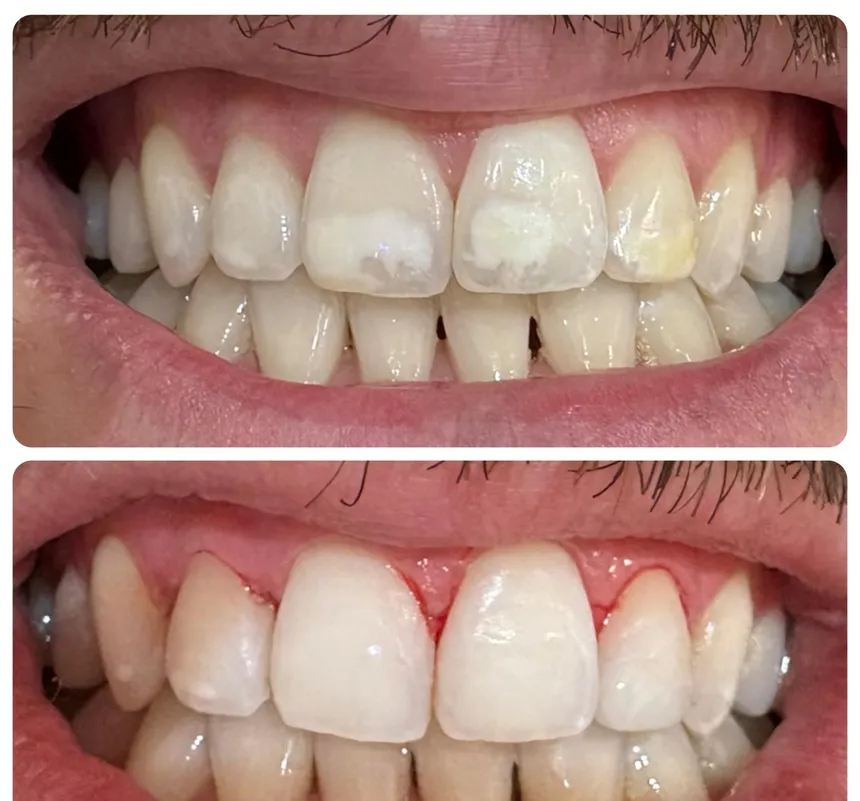
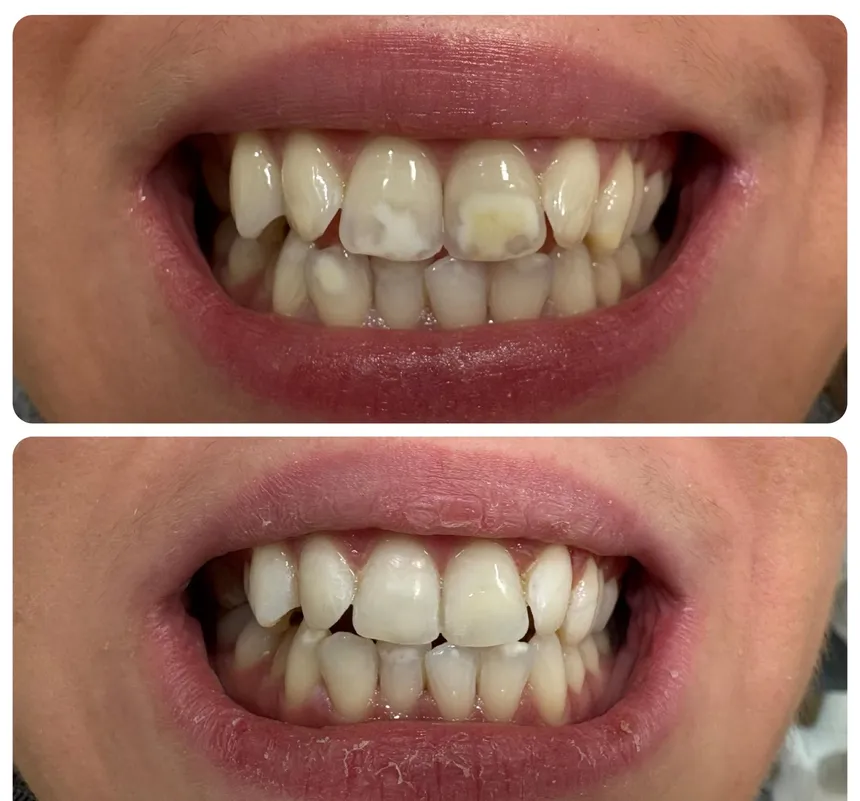
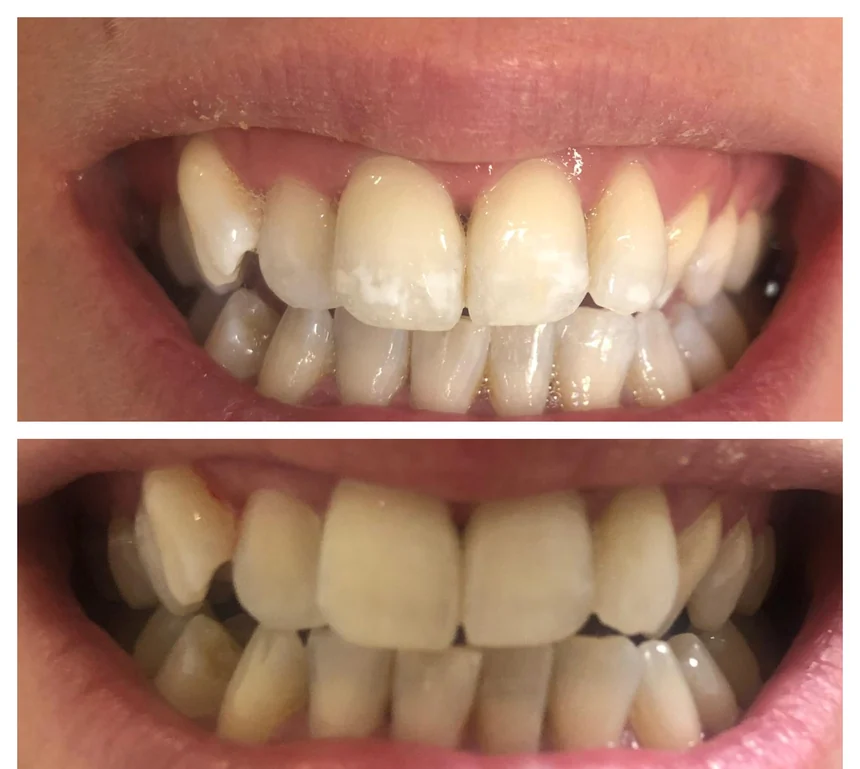
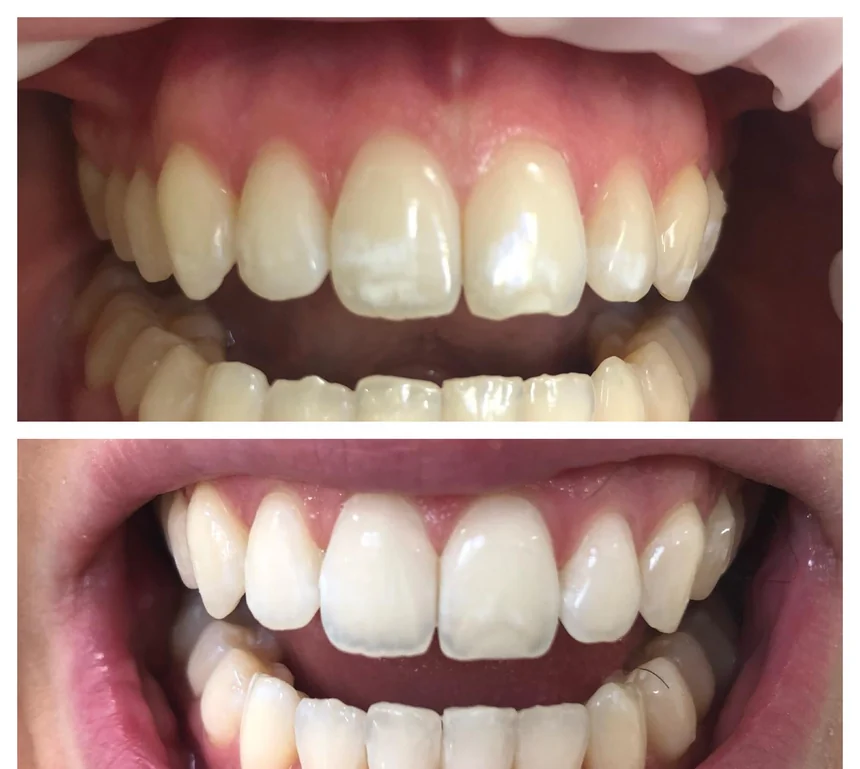
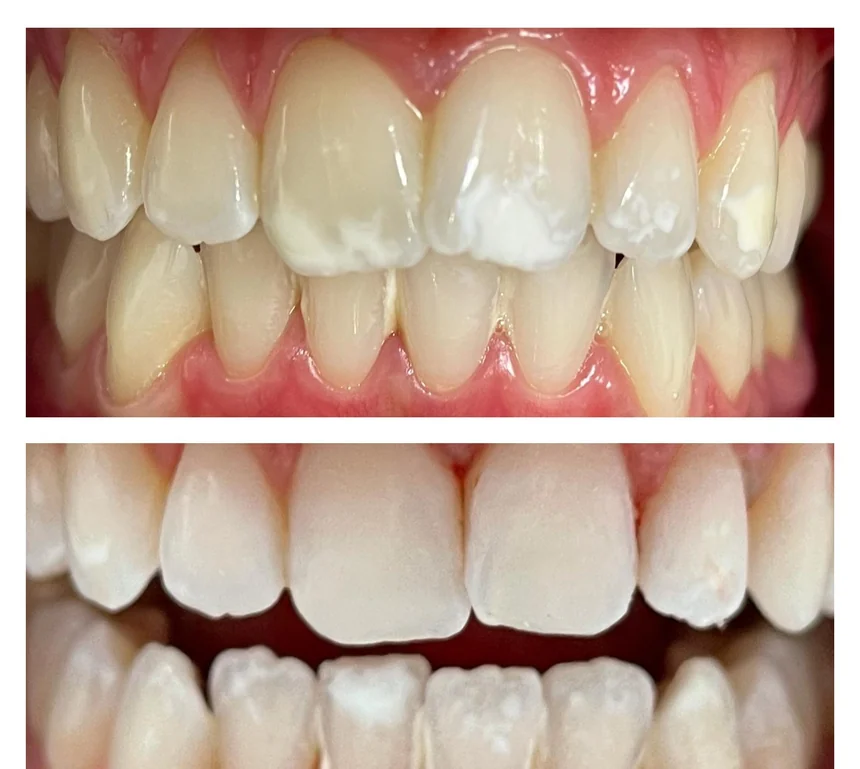
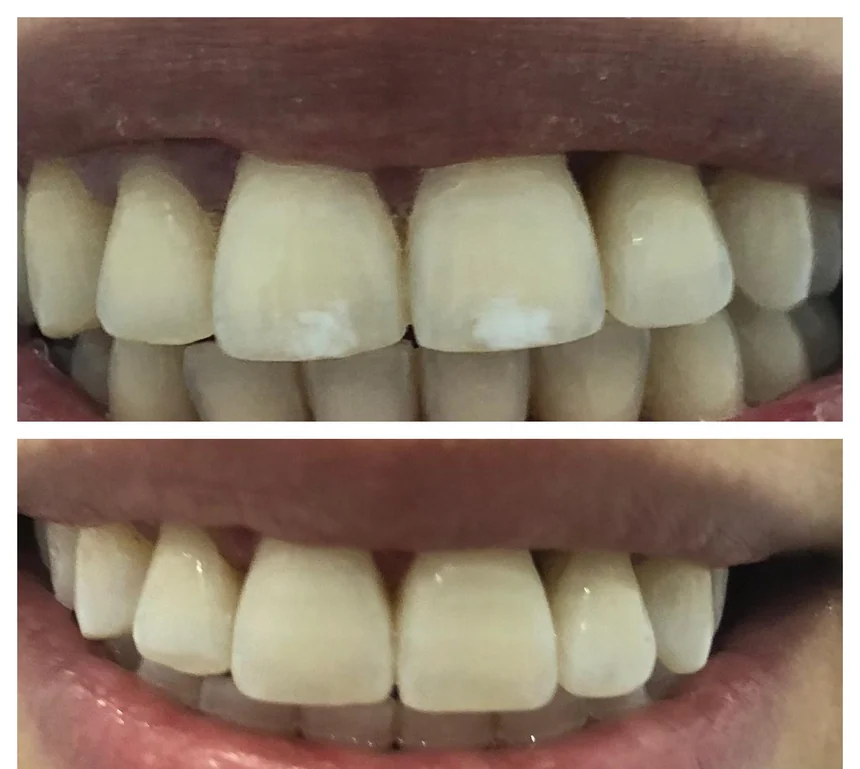
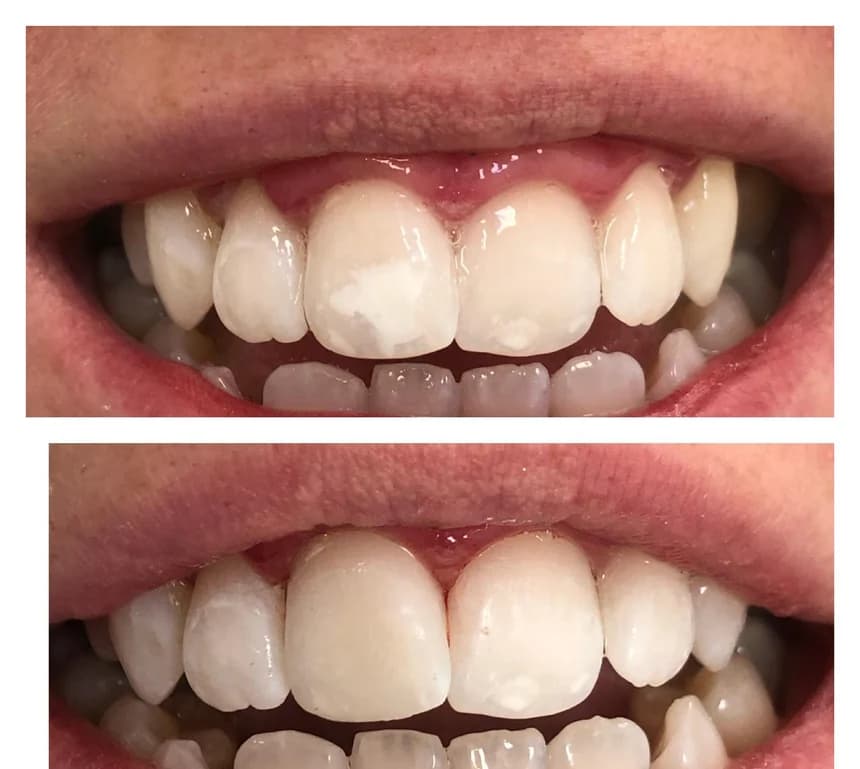
In accordance with our professional code of conduct, these photographs do not represent a guaranteed result: results vary according to each clinical situation.
Result & longevity
The result is immediate and stable: the resin integrates with the enamel and the masking of the spot is long-lasting.
The treated area does not “re-stain” like a surface stain. A slight change in the shade of the teeth over the years remains possible; a regular check-up allows this to be monitored. Infiltration can also be combined with whitening, carried out beforehand, when the overall shade also needs to be lightened.
Treatment pricing & quotes
The treatment of white spots is a cosmetic treatment: it is not covered by the Assurance Maladie. The cost depends on the number of teeth involved.
Fees — Dr Laura Zeitoun Saal practice, Paris 8
A written, detailed quote is provided after the first diagnosis appointment, before any treatment.
Your white spots treated in Paris 8, avenue George V
Dr Laura Zeitoun Saal’s practice is located at 45 avenue George V, in the heart of the Triangle d’Or, in the 8th arrondissement of Paris — between the Champs-Élysées and the Seine.
It welcomes patients by appointment, and access is direct from anywhere in Paris: George V station, on line 1, is a few steps from the practice; Alma–Marceau, on line 9, is two streets away. The Champs-Élysées are at the end of the avenue.
It is the treatment on this site that requires the fewest visits: the majority of superficial spots are treated in a single session, diagnosis included. The practice accordingly welcomes patients from across Paris and from throughout the Île-de-France.