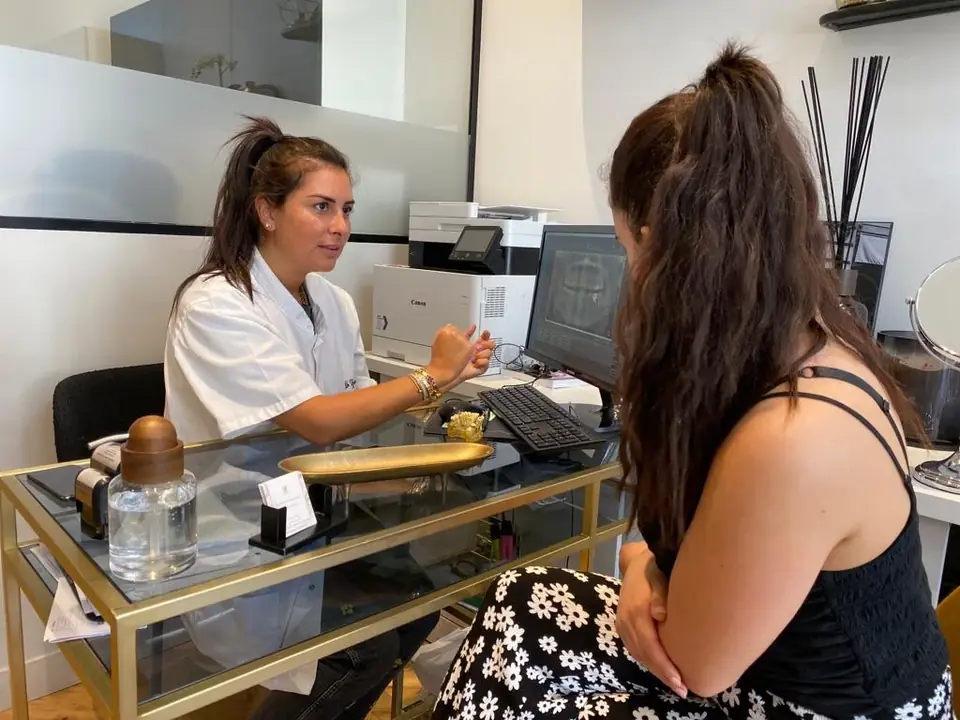
What is a ceramic veneer?
A veneer covers only the visible surface of the tooth, unlike a crown, which encases it entirely. It is an additive cosmetic treatment: a fine layer of ceramic is added rather than the tooth being ground down.
Adhesively bonded to the enamel, the ceramic reproduces the natural translucency of the tooth and offers lasting resistance to staining from coffee, tea or tobacco. In Dr Zeitoun Saal’s practice in Paris 8, each veneer is designed from a prior analysis of the smile and the proportions of the face — never from a catalogue.
Dr Saal’s approach
Dr Laura Zeitoun Saal directs her practice towards cosmetic dentistry. Her guiding principle for veneers: to do as little as possible to the tooth, and to be as precise as possible about the result.
“A successful veneer goes unnoticed: it is forgotten. My role is not to fit a standardised smile, but to reveal your own — while preserving your natural teeth as far as possible.”
— Dr Laura Zeitoun Saal, dental surgeon, Paris 8
Trained in smile aesthetics in Strasbourg and holding a doctorate in dental surgery (Faculté de Garancière), Dr Saal designs each case individually: study of the proportions, selection of the shade, and approval of a project before any procedure.
When are veneers indicated?
Veneers address specific cosmetic situations in the anterior region (the teeth of the smile), when teeth whitening or a simpler treatment is not enough.
- Persistent discolouration that whitening cannot correct: non-vital teeth, stains, fluorosis, tetracycline dyschromia.
- Gaps between the teeth (diastemata) to be closed.
- Worn, chipped or slightly fractured teeth.
- Minor misalignments, without resorting to orthodontics.
- Harmonisation of the shape and proportions of the smile.
Veneers are not suited to every situation. At the first appointment in Paris 8, Dr Saal checks that the indication genuinely holds; the following section sets out the cases in which another solution comes first.
When veneers are not indicated
Fitting veneers in a mouth that is not ready for them is to prepare an unstable result. Some situations call for another treatment first; others point towards a different solution altogether.
- An unfavourable occlusion — an abnormal contact between the arches, or marked bruxism, subjects the ceramic to repeated strain. The occlusion is adjusted, or the teeth protected, before fitting is considered.
- Significant misalignment — veneers correct the appearance of small discrepancies. Beyond that, it is orthodontics that genuinely repositions the teeth, with a cosmetic refinement considered afterwards if needed.
- Insufficient enamel — bonding holds on enamel. When too little of it remains, adhesion is no longer reliable, and a veneer that does not bond does not last.
- Teeth that are too thin or too worn — these need rebuilding before they can be dressed. That is the territory of a smile makeover, not of a single veneer.
- Insufficient oral hygiene — the margin between veneer and gum calls for rigorous brushing and regular check-ups. Without them, it is the join that is exposed.
- A severely decayed tooth — when a large part of the tooth is missing, a crown covers and protects, where a veneer only dresses the visible surface.
- Periodontal disease — diseased gums destabilise the support of the teeth. The periodontium is treated first; the cosmetic work comes afterwards, on stable foundations.
Most of these situations can be treated, and the question of veneers then arises again. That is precisely what the first appointment in Paris 8 is for: to check the indication, to confirm it when it holds, and to say so when it does not.
Veneer, crown, whitening or orthodontics?
A veneer is not the only way to rework a smile. What sets it apart can be put in one sentence: it acts on the visible surface of the tooth, and on that alone.
- Compared with a crown: less tissue removed. A crown encases the whole tooth and requires it to be trimmed all the way round. A veneer covers only the visible surface, with minimal preparation — or none at all. Where both are indicated, it is the option that preserves the most natural tooth.
- Compared with whitening: it acts where shade alone is not enough. Whitening works on the colour of natural teeth, and on nothing else. On a non-vital tooth, long-standing dyschromia, or a shape or gap to be reworked, it reaches its limit: a veneer changes shade, shape and proportions in a single step.
- Compared with orthodontics: an alternative for small discrepancies. Orthodontics genuinely moves the teeth, and remains the reference treatment as soon as the discrepancy is significant. For slight crowding or a gap to be closed, a veneer achieves a visible result without moving any tooth.
These options are not mutually exclusive: they are frequently combined. Whitening often precedes fitting in order to set the reference shade, and orthodontics can prepare the ground. The choice is made on your situation, not on a principle.
Ceramic or composite veneer?
Both correct the aesthetics, but differ in material, lifespan and cost. Ceramic offers superior appearance and longevity; composite, applied chairside in a single session, remains more affordable. The practice has chosen to work exclusively in ceramic: composite appears here for comparison only, it is not offered.
| Criterion | Ceramic veneer | Composite veneer |
|---|---|---|
| Fabrication | In the laboratory, from an impression | Chairside, directly |
| Indicative lifespan | 10 to 20 years | 5 to 7 years |
| Stain resistance | High | Lower, re-stains over time |
| Reversibility | Depending on the preparation | More reversible |
| Number of sessions | 2 to 3 | 1 |
| Fees | €€€ | €€ |
How many veneers are needed?
There is no standard number. What determines it is the area that shows when you smile.
In some patients the smile reveals four teeth; in others, eight or ten. The whole of what shows is treated, so that no dressed tooth stands out against its neighbour: it is the symmetry of the smile that decides, not a figure. Depending on the case, 2, 4, 6, 8 or 10 teeth are therefore treated. The number is determined during the initial analysis, from photographs, and appears on the quote before any treatment.
The treatment, step by step
At the practice, fitting veneers follows a precise sequence. The first three stages are stages of design: nothing is trimmed and nothing is bonded until the project has been approved with you.
Analysis of the smile
Photographs, facial proportions, smile line, tooth length and starting shade. Your request is recorded exactly as you put it.
Cosmetic project
From that analysis, Dr Saal designs the intended shape, length and proportions, tooth by tooth.
Try-in & approval
The project is placed temporarily over your teeth. You look at it, you discuss it, it is adjusted — before any irreversible procedure.
Minimal preparation & impression
Very conservative preparation of the tooth where necessary, then an impression sent to the laboratory.
Fitting & bonding
Try-in of the definitive veneers, bonding and adjustment of the occlusion for a stable and comfortable result.
The design phase deliberately takes up the greater part of the treatment. The analysis starts from photographs and from the proportions of your face: the smile line, the position of the incisors, the length of the teeth, the starting shade. From that reading a cosmetic project emerges — a drawing, then a model. That model is tried in the mouth: you see the intended shape on your own teeth, you comment on it, it is adjusted. Only once the project has been approved by you does preparation begin. It is this order that makes the practice’s approach a conservative one: decide before acting, never the other way round.
After the fitting
Fitting veneers is not a major procedure, but it does leave a few days of adjustment. Here is what is expected — and what is not.
- Sensitivity to hot and cold — common in the days that follow, particularly where the tooth has been prepared. It subsides on its own.
- A reactive gum — slightly red or tender when brushing for a few days, while it settles around the new margin.
- A feeling of thickness — the tongue seeks out the new shapes over the first few days, then stops noticing them.
- A contact to be rechecked — if the occlusion does not feel right when you close your teeth, the adjustment takes a few minutes in the chair.
What should prompt you to call the practice, without waiting: pain that settles in or intensifies rather than easing, sensitivity that persists rather than fading, a gum that stays swollen or bleeds, a contact that interferes with chewing, or a veneer that moves. These situations are all the easier to resolve for being seen early.
Clinical cases
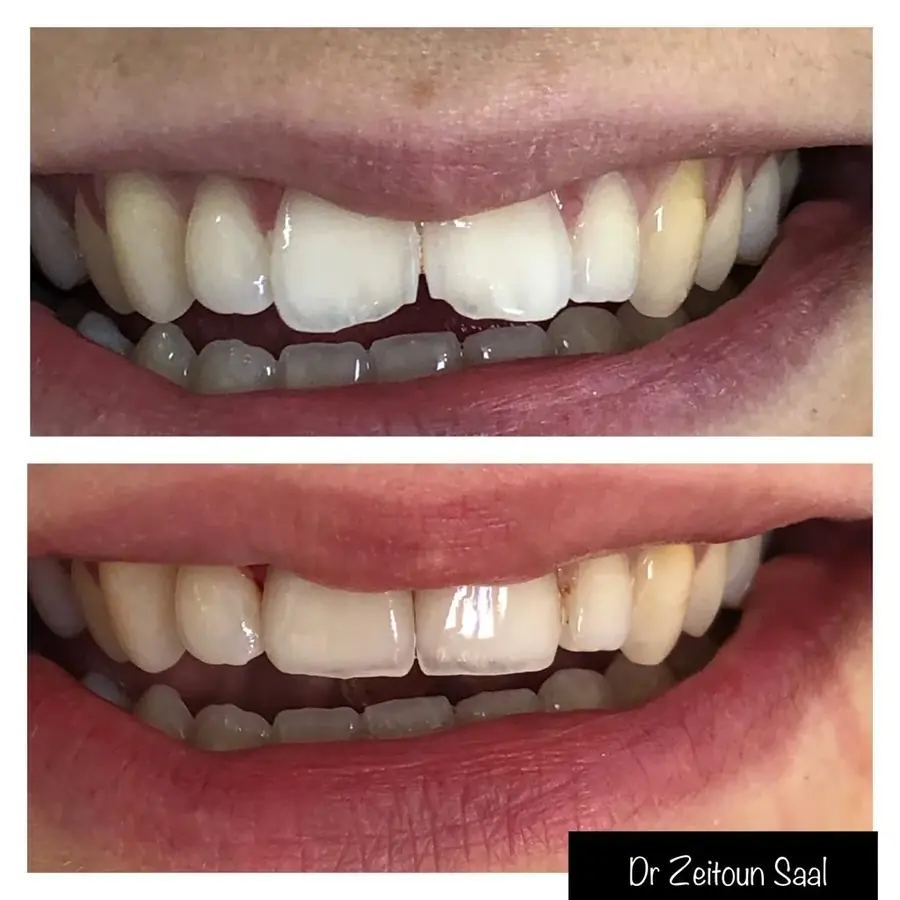
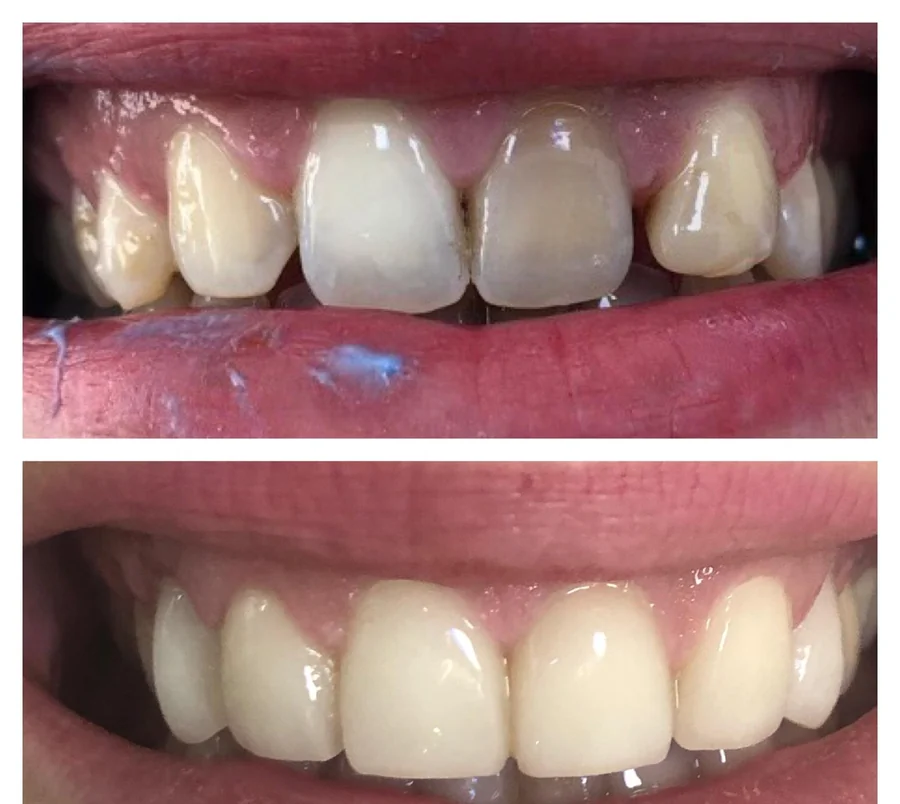
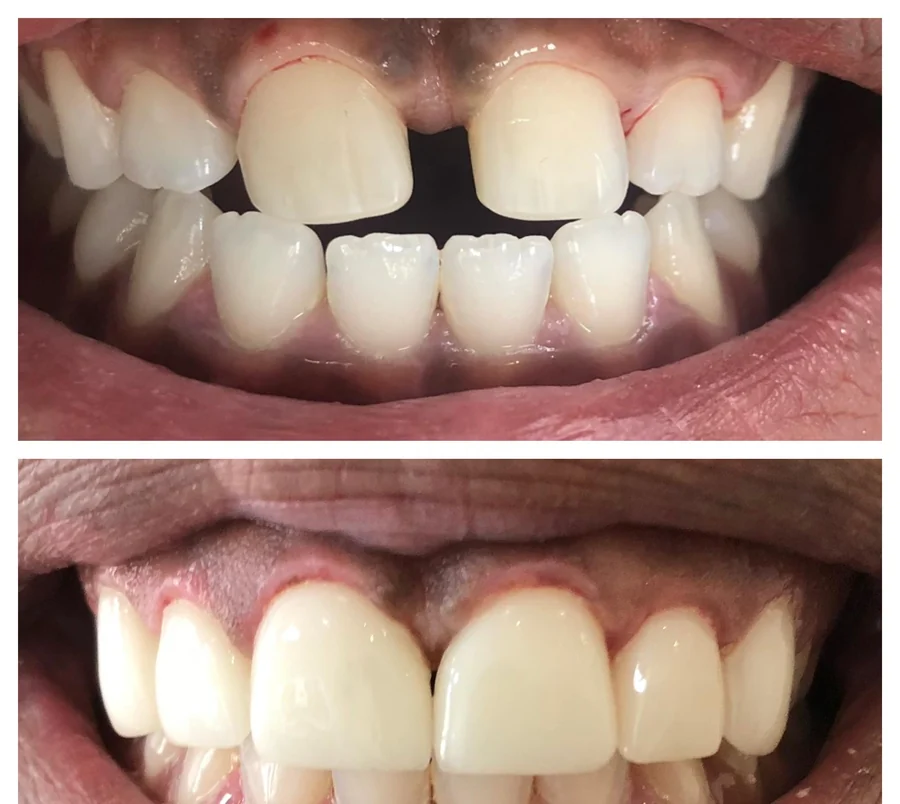
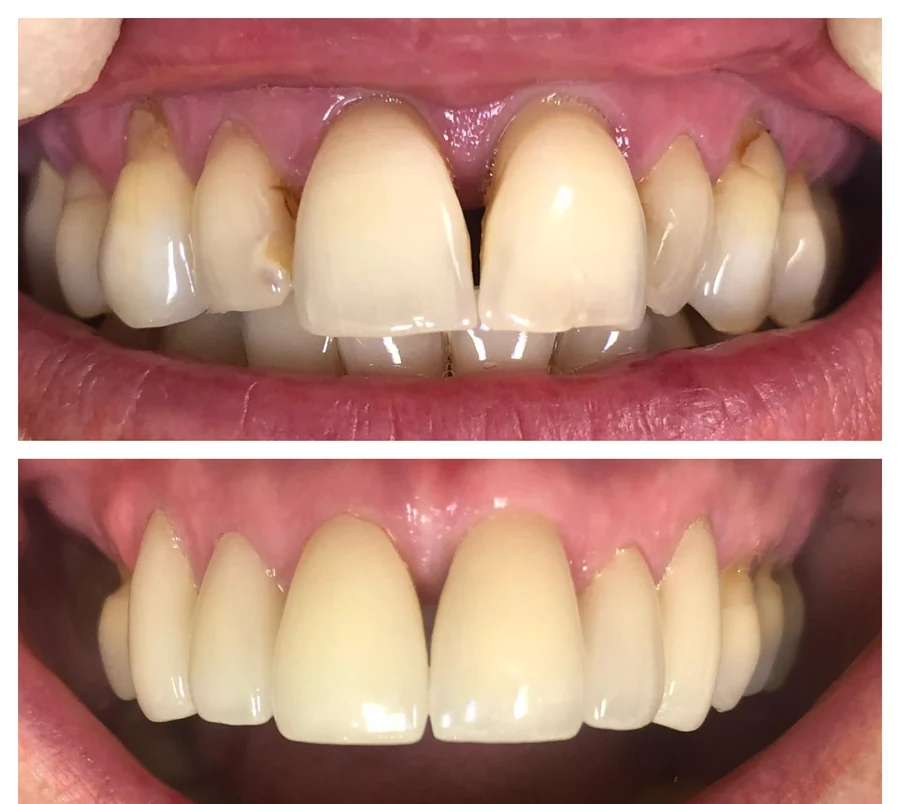
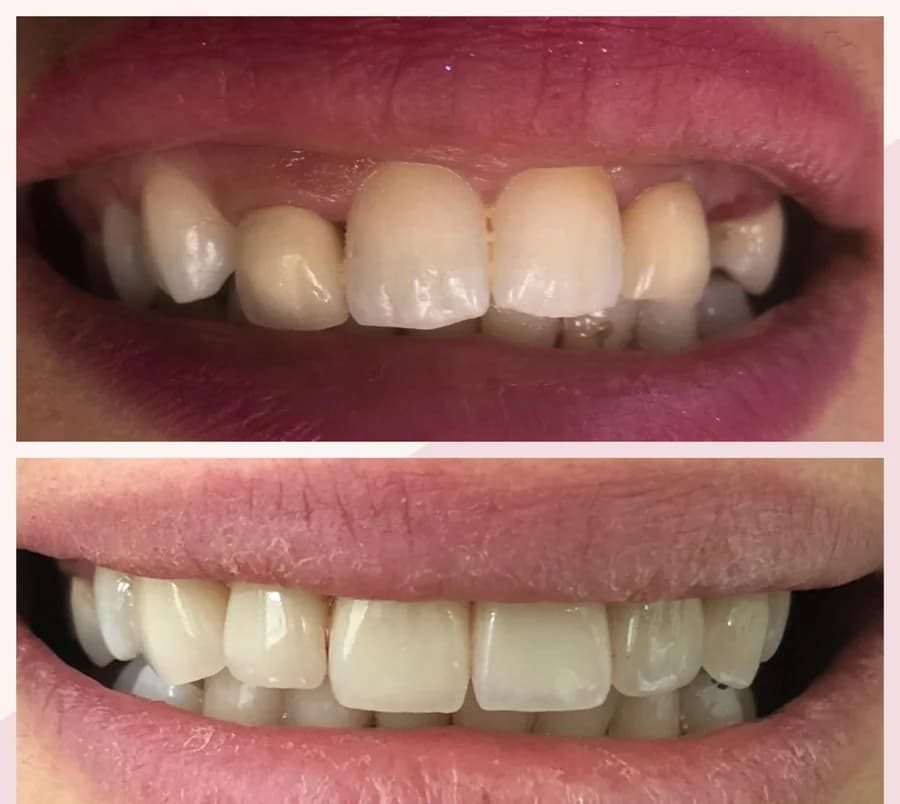
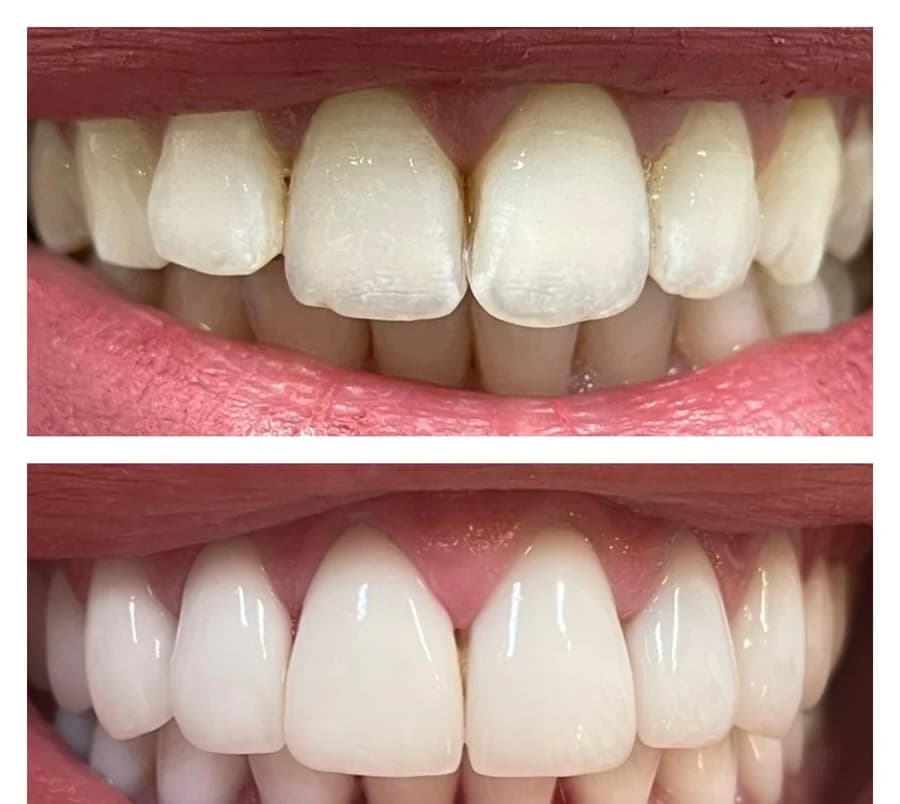
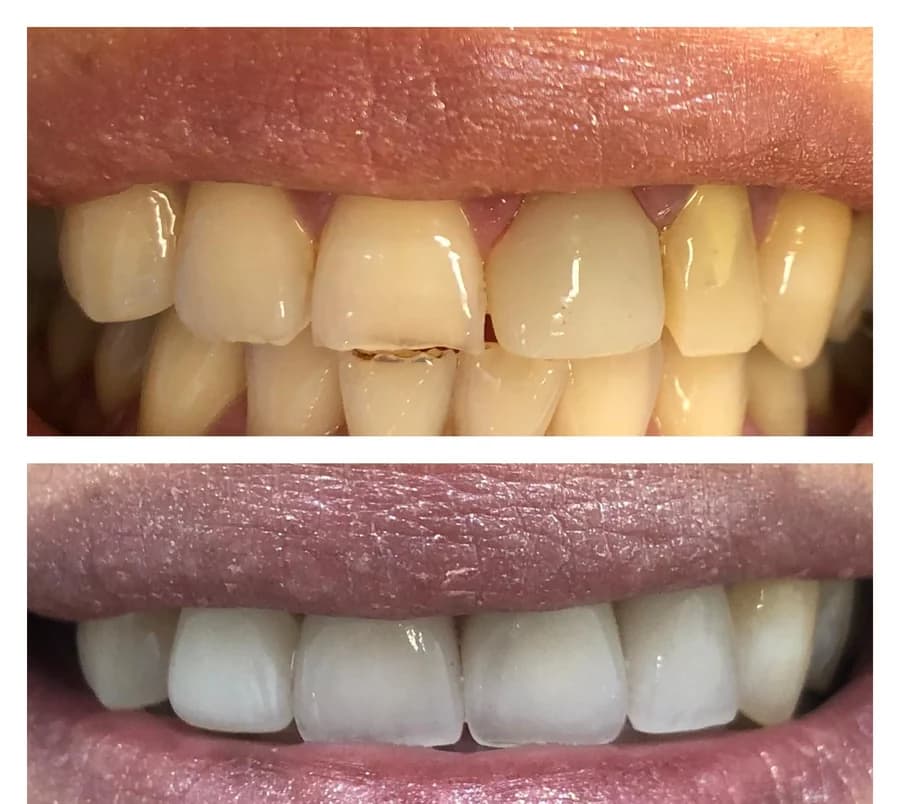
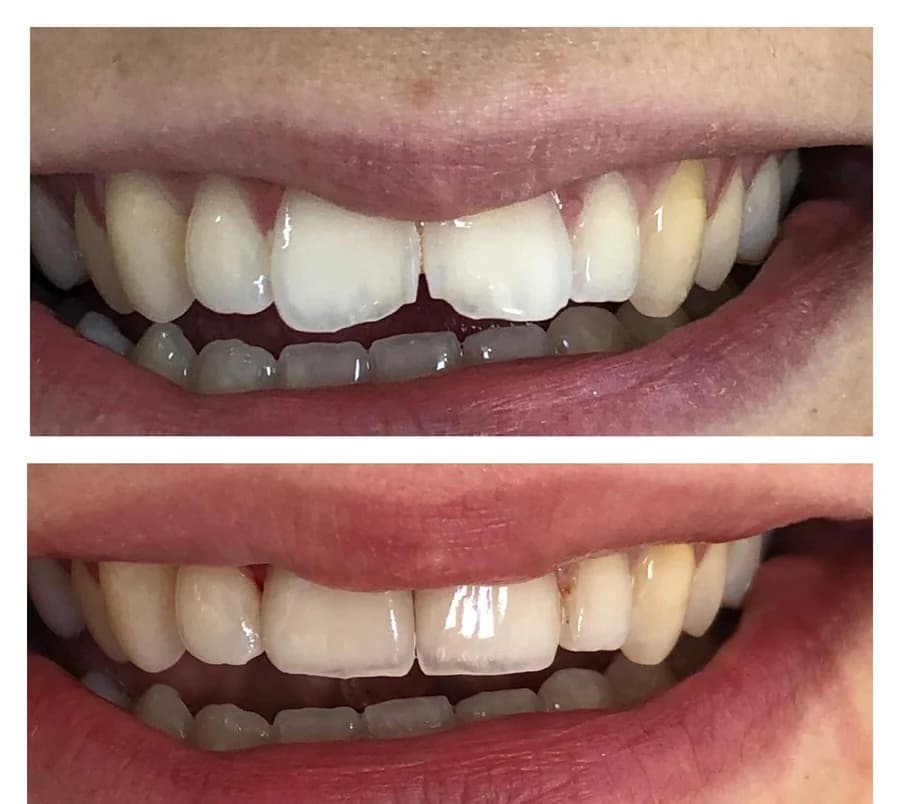
In accordance with our professional code of conduct, these photographs do not represent a guaranteed result: results vary according to each clinical situation.
Lifespan & maintenance
A ceramic veneer generally lasts from 10 to 20 years. Clinical literature reports survival rates of around 95% at ten years.
Its longevity depends on hygiene, occlusion and habits. To preserve it: careful brushing, regular check-ups at the practice, wearing a night guard in the event of bruxism, and caution with very hard foods or objects. Veneers do not discolour, but the neighbouring natural teeth may change over time; the follow-up provided by Dr Saal maintains the harmony of the smile over the years.
Veneer pricing & quotes
The practice has chosen to work exclusively in ceramic. Fees are quoted per tooth and a written, detailed quote is provided before any treatment; whitening, when indicated, is carried out beforehand to establish the reference shade.
Indicative fees — Dr Saal’s practice, Paris 8
Indicative amounts. A written, detailed quote is always provided after the first analysis appointment, before any treatment.
Your dental veneers in Paris 8, avenue George V
Dr Laura Zeitoun Saal’s practice is located at 45 avenue George V, in the heart of the Triangle d’Or, in the 8th arrondissement of Paris — between the Champs-Élysées and the Seine.
It welcomes patients by appointment, and access is direct from anywhere in Paris: George V station, on line 1, is a few steps from the practice; Alma–Marceau, on line 9, is two streets away. The Champs-Élysées are at the end of the avenue.
Patients who come for veneers are not all from the 8th arrondissement: the practice welcomes them from across Paris and from throughout the Île-de-France. That is in the nature of a treatment that is prepared — a veneer project is built over several spaced-out appointments, and continuity of follow-up matters more than immediate proximity.