What is teeth whitening?
Whitening lightens the shade of the natural teeth using a peroxide-based gel, without removing any tooth structure.
The gel releases oxygen that penetrates the enamel and dentine and breaks down the pigments responsible for yellowing. Unlike “whitening” toothpastes, which act on the surface through abrasion, whitening works deep within the shade of the tooth. Carried out under a dental surgeon’s supervision, it does not damage the enamel: it is the concentration of the gel, the condition of the teeth and the follow-up that make the difference between a safe procedure and a poorly controlled over-the-counter product.
“Whitening” or “bleaching”?
It is the same treatment. Dental surgeons speak of “whitening” because the aim is to reveal the natural shade of the tooth, not to make it artificially white.
The distinction also matters in practice. Whitening here is preceded by an examination: Dr Saal checks the indication, assesses the condition of the teeth and gums, then selects the product and supervises how it is applied. Neither kits sold online nor treatments offered in beauty salons include that examination.
Indications & limits
Whitening gives its best results on natural teeth that have yellowed or dulled. It also has limits that it is only honest to know before starting.
- Teeth yellowed by age or by coffee, tea or tobacco (so-called extrinsic staining).
- A dull natural shade that one wishes to lighten by a few tones.
- Before a cosmetic project (veneers, composites) to define the reference shade.
Whitening has its limits, and a few situations contraindicate it — at least for the time being. The following section sets them out; it is the examination at the first appointment that decides.
When whitening is not indicated
What contraindicates whitening rarely has to do with the product: it has to do with the state of the mouth at the moment it is considered.
- Decay or a restoration to be redone — the examination looks for these before any protocol. They are treated first, and the question of whitening then arises again.
- An inflamed gum — the gel is applied right up against the gum, which a bespoke tray protects. That still requires the gum to be healthy to begin with.
- Pre-existing sensitivity — this does not rule whitening out, it changes the protocol: a lower concentration, shorter periods of wear, desensitising gels.
- Restorations on the teeth of the smile — crowns, veneers and composites do not lighten. On an anterior region that has already been restored, whitening widens a difference in shade rather than correcting it.
- Grey discolouration, or discolouration linked to tetracyclines — these respond less well than yellow staining. A result is achievable, but a more limited one; it is stated beforehand, not discovered afterwards.
- White spots — whitening can make them temporarily more visible. They call for a different treatment, to be sequenced with this one rather than ignored.
- Pregnancy and breastfeeding — whitening is advised against during these periods, as a precaution. It is not an urgent treatment: it can be postponed without consequence.
None of these situations is a definitive refusal: most can be treated, and the indication is then reassessed. That is what the examination at the first appointment in Paris 8 is for — to check that whitening will deliver what you expect of it, and to say so when it will not.
Whitening, veneers or infiltration?
Whitening does only one thing, but it does it without removing anything from the tooth or adding anything to it. That is what sets it apart from the other options.
- Compared with veneers: the lightest intervention. Whitening works on the shade of the natural teeth, with no preparation and no added material. A veneer changes the shade, but also the shape and the proportions — by covering the tooth. When the request concerns colour alone, whitening answers it without committing to anything irreversible.
- Compared with resin infiltration: two different targets. Whitening acts on the overall shade; infiltration masks a localised white spot. On a white spot, whitening can even make it temporarily more visible. These are not two competitors but two answers to two problems.
- Compared with toothpastes and kits: two different mechanisms. “Whitening” toothpastes act on the surface, through abrasion. Whitening acts on the shade of the tooth itself. And what separates the procedure from the product is the examination that precedes it.
These options combine more often than they compete. Whitening frequently precedes the fitting of veneers, in order to set the reference shade; it also precedes infiltration when the overall shade needs reworking as well as the spot. It is the order that matters, and it is decided at the diagnosis.
A take-home protocol, no in-chair session
At Dr Saal’s practice, whitening is carried out as a take-home protocol: bespoke trays, made from your impressions, which you wear at home with a gel whose concentration is tailored to your sensitivity. So-called “in-chair” whitening, carried out in a single session at the practice with a more concentrated gel, is not offered there.
- At home, over several days — the trays are worn at home, according to the protocol agreed with Dr Saal after the diagnosis.
- A gel dosed to your sensitivity — the concentration is chosen at the outset, then adjusted if need be during the protocol: a lower concentration, shorter periods of wear, a desensitising gel.
- A gradual, controlled result — the shade settles application after application, and is measured against the photographs taken before starting.
- Trays that you keep — they are then used for the occasional touch-ups that maintain the result.
The concentration of the gel and the length of the periods of wear are decided with Dr Saal after the diagnosis, according to your starting shade and your sensitivity.
The treatment, step by step
Whitening follows a simple sequence, but it always begins with an examination. The first two stages lighten nothing: they decide whether it is possible, and from what starting point.
Prior examination
The condition of the teeth and gums, a search for decay and for restorations to be redone, and an assessment of your sensitivity.
Starting shade & photographs
Recording of the initial shade and reference photographs: this is what will make it possible to measure the result rather than judge it from memory.
Impressions & bespoke trays
Fabrication of trays fitted to your arches, for an even application of the gel and protection of the gums.
Whitening protocol
Wearing the trays at home, according to the agreed protocol, with a gel whose concentration is tailored to your sensitivity.
Check-up & maintenance
Verification of the result, dietary and hygiene advice, and a touch-up plan to make the shade last.
The diagnosis is not a formality preceding the treatment: it is what determines the protocol. Untreated decay, an inflamed gum, marked sensitivity or a crown visible in the smile region do not weigh in the same way — some postpone whitening, others modify it, others again change what should be expected of it. Recording the starting shade and taking photographs before beginning follows the same logic: a gradual result cannot be judged from memory, it has to be compared.
What result to expect
Whitening lightens the shade by a few tones, gradually. The result depends on the starting colour and the origin of the discolouration; it varies from one person to another.
The reference point is not an ideal shade but your own starting shade — hence the record and the photographs taken before beginning. Two people who start from different colours do not arrive at the same place, and the difference is read from those images rather than from memory. After the treatment, the teeth continue to change according to habits (coffee, tea, tobacco), hence the value of touch-ups.
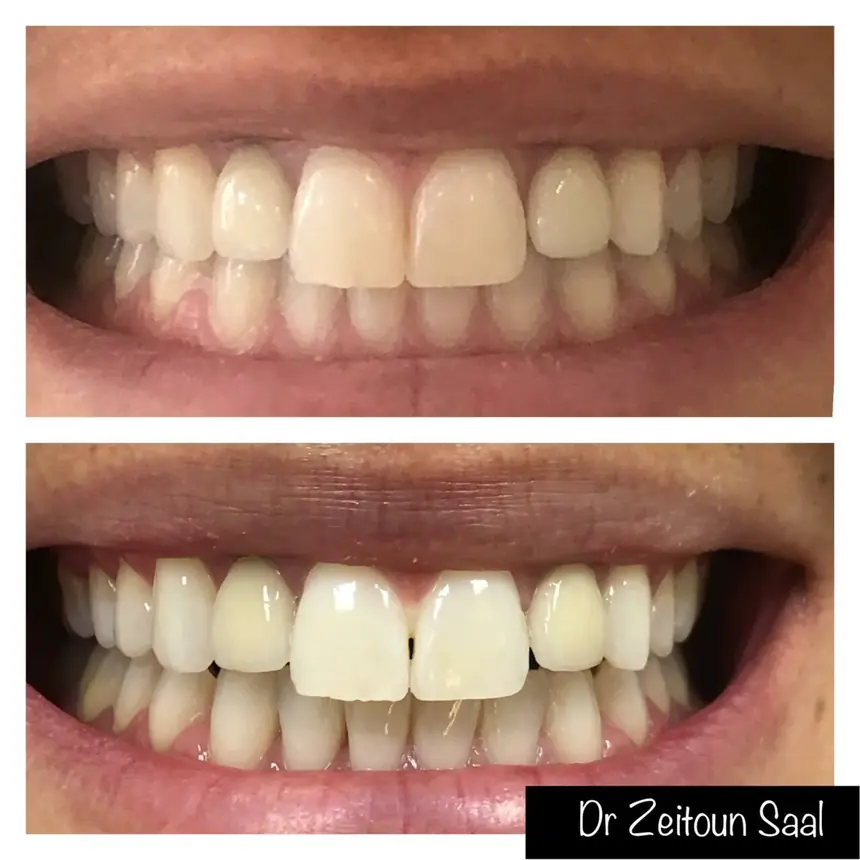
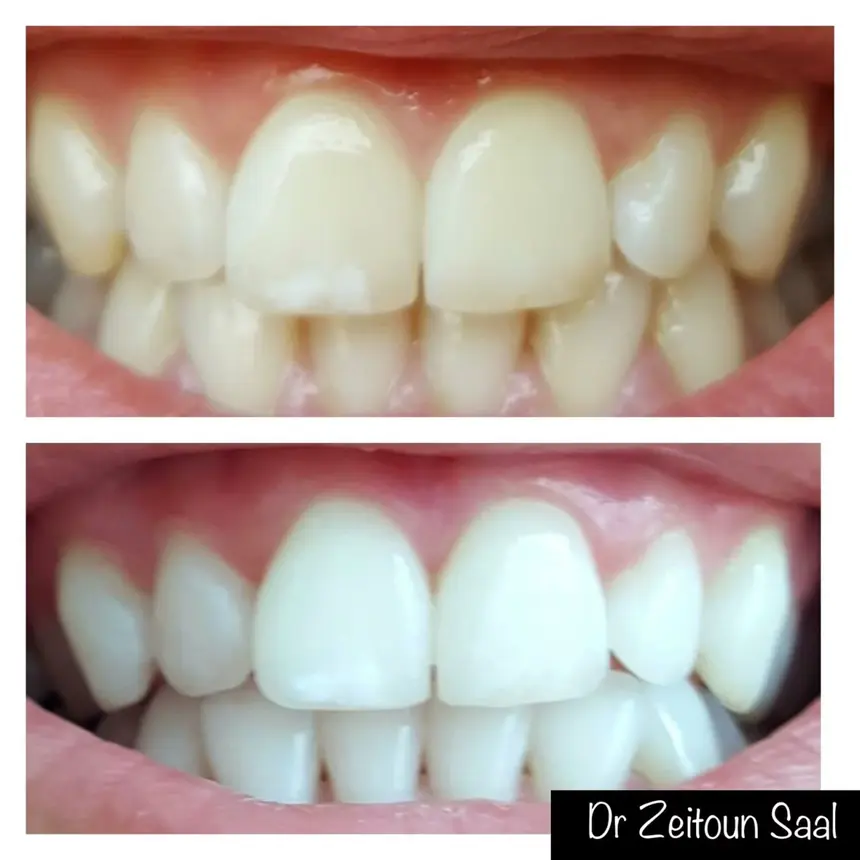
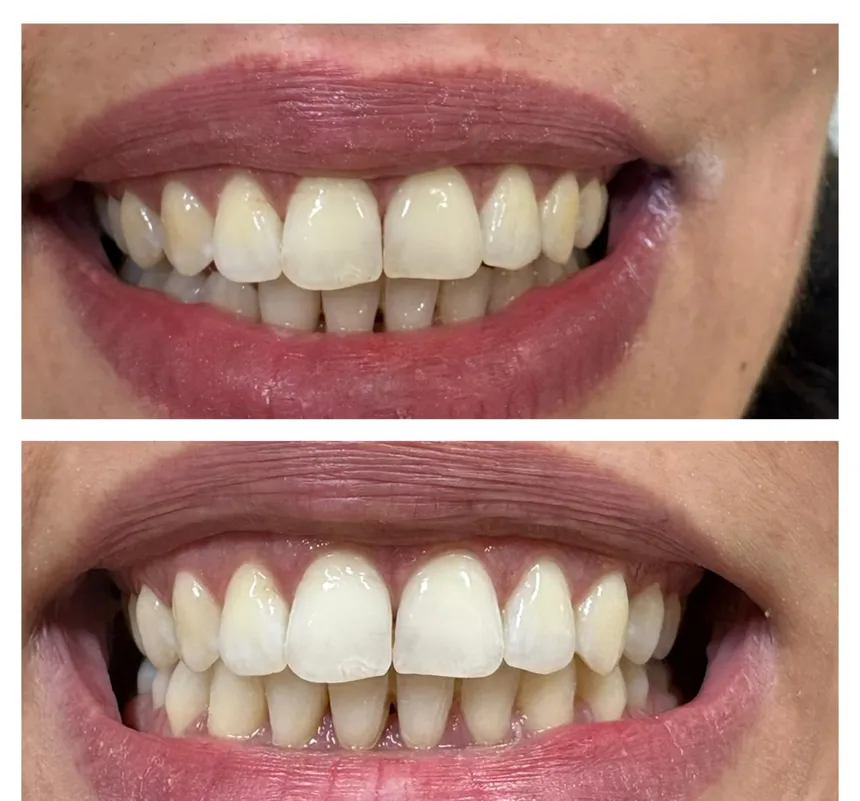
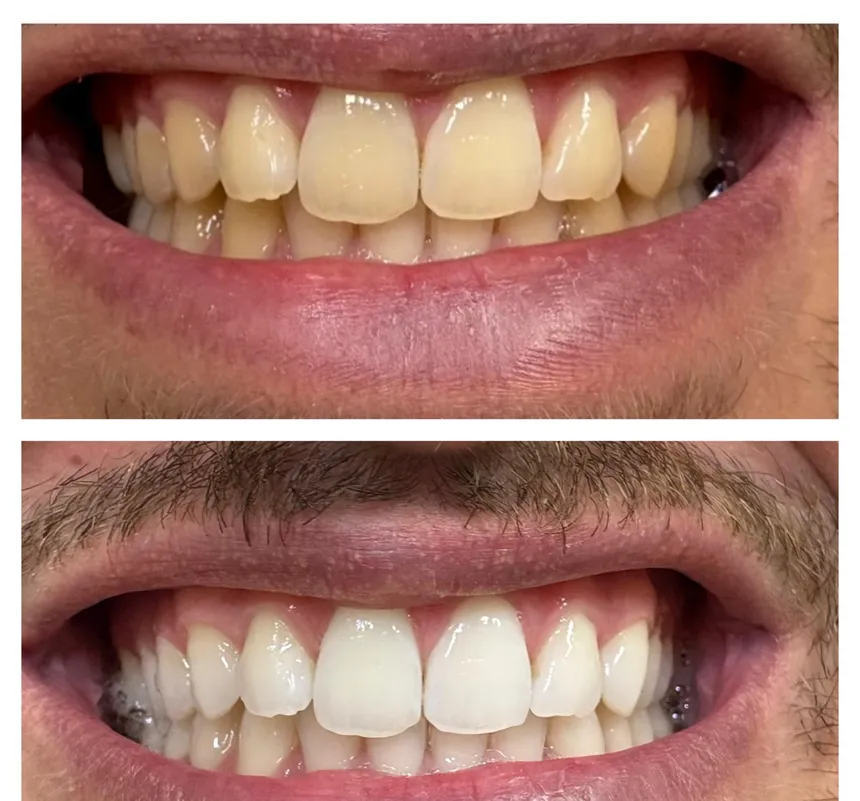
In accordance with our professional code of conduct, these photographs do not represent a guaranteed result: results vary according to each clinical situation.
After the protocol
Whitening leaves neither time off nor convalescence. It does leave more sensitive teeth for the duration of the protocol: that is the most common after-effect, and it can be managed.
- Sensitivity to hot and cold — common during the protocol. It is managed by lowering the concentration of the gel, spacing out the periods of wear, and using desensitising gels. It disappears once the treatment is over.
- A shade that is not yet even — the result settles gradually, application after application. Judging the colour before the end of the protocol tells you nothing.
- Dietary advice to follow — it concerns the sources of staining: coffee, tea, red wine, tobacco. It is given to you at the check-up, along with the touch-up plan.
What should prompt you to tell the practice, without waiting: pain that sets in instead of sensitivity that passes, a gum that stays irritated or bleeds, a tray that rubs or does not stay in place. None of these situations resolves by carrying on with the protocol; all of them resolve by picking up the telephone.
Duration & maintenance
Whitening generally lasts from 1 to 3 years, depending on hygiene and consumption habits.
Coffee, tea, red wine and tobacco gradually re-stain the teeth. To prolong the result: limit these sources of discolouration, brush carefully, and carry out occasional touch-ups with your trays. Dr Saal decides with you the appropriate maintenance schedule.
Whitening pricing & quotes
Whitening is a cosmetic treatment: it is not covered by the Assurance Maladie or by most complementary health insurers. The fee below covers the complete treatment.
Fees — Dr Saal’s practice, Paris 8
A written, detailed quote is provided after the first diagnosis appointment, before any treatment.
Your teeth whitening in Paris 8, avenue George V
Dr Laura Zeitoun Saal’s practice is located at 45 avenue George V, in the heart of the Triangle d’Or, in the 8th arrondissement of Paris — between the Champs-Élysées and the Seine.
It welcomes patients by appointment, and access is direct from anywhere in Paris: George V station, on line 1, is a few steps from the practice; Alma–Marceau, on line 9, is two streets away. The Champs-Élysées are at the end of the avenue.
Whitening lends itself well to this geography: the take-home protocol continues at home, between two spaced-out appointments. The practice accordingly welcomes patients from across Paris and from throughout the Île-de-France.