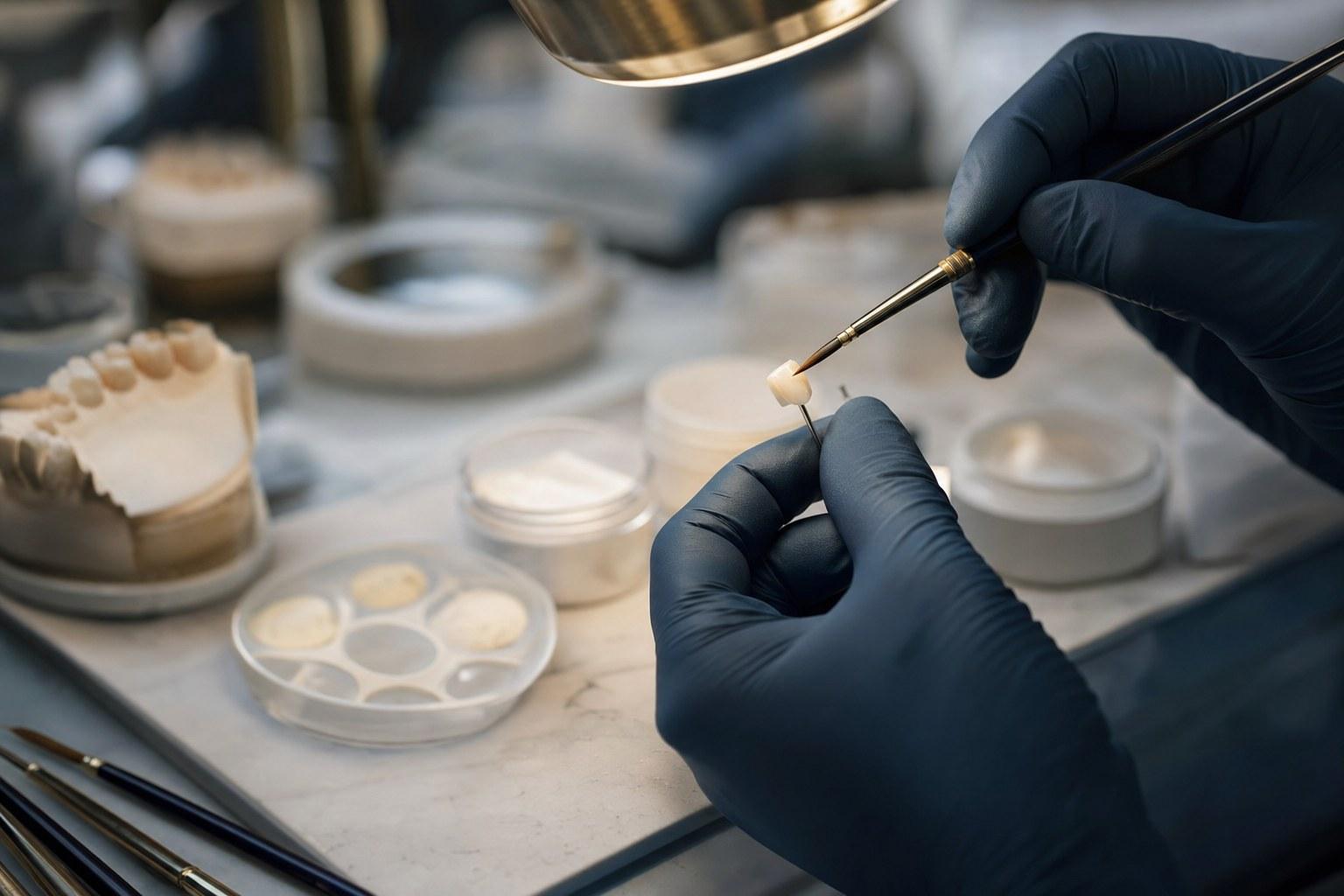
What sets two veneers apart?
A veneer is a fine layer of ceramic, roughly 0.3 to 0.7 mm thick, bonded to the visible surface of the tooth.
Within this range, the thickness chosen depends on what needs correcting. A slight change of shade does not call for the same layer of ceramic as reworking the shape of a tooth or masking long-standing discolouration.
Translucency matters just as much. The ceramic must let light through as enamel does, so that the tooth keeps a natural appearance next to its neighbours.
The two main families of ceramics
Two families are most commonly used for veneers. Dr Saal will tell you which one suits your case.
| Feldspathic ceramic | Lithium disilicate | |
|---|---|---|
| Main strength | Thinness and translucency | Mechanical strength |
| Indicated for | Slight corrections on teeth with little discolouration | Reshaping, shades to be masked |
| Bonding | To the enamel | To the enamel |
How much is the tooth prepared?
Dr Saal favours minimal preparation.
Once a fine layer of enamel has been removed, the step can no longer be reversed: the tooth will have to stay covered. This is why the project is tried in the mouth and approved before any irreversible step.
The project is approved beforehand by trying in a wax-up made in the laboratory, then tried in the mouth in resin.
What about composite?
Composite is a resin applied chairside in a single session, without a laboratory. It ages less well than ceramic: it generally lasts 5 to 7 years, compared with 10 to 20 years for ceramic, stains more easily and looks less natural.
The practice has chosen to work only with ceramic and therefore does not fit composite veneers.
How is the choice made?
- Analysis of the smileExamination, photographs, proportions of your face, smile line and starting shade.
- Project tried in the mouthYou see the intended result before any irreversible step.
- Written quoteYou receive it before any treatment. Fees range from €950 to €1,500 per tooth, depending on the number of teeth and the complexity of the case.
Frequently asked questions
Are the thinnest veneers the best?
Does the type of ceramic change the lifespan?
Related reading: Ceramic veneers · Lifespan and maintenance · Risks, removal, replacing a veneer